Research
The Middle Path: Rethinking Human Progress in the Age of Artificial Intelligence
As artificial intelligence reshapes work, education, and governance, the real challenge is not whether AI will replace humans, but whether humans will continue to exercise the judgment, creativity, and critical thinking that define them. This article argues for a balanced, human-centric approach where AI augments not replaces human intelligence, and outlines key policy priorities to ensure technology strengthens society while preserving human cognitive capacity.
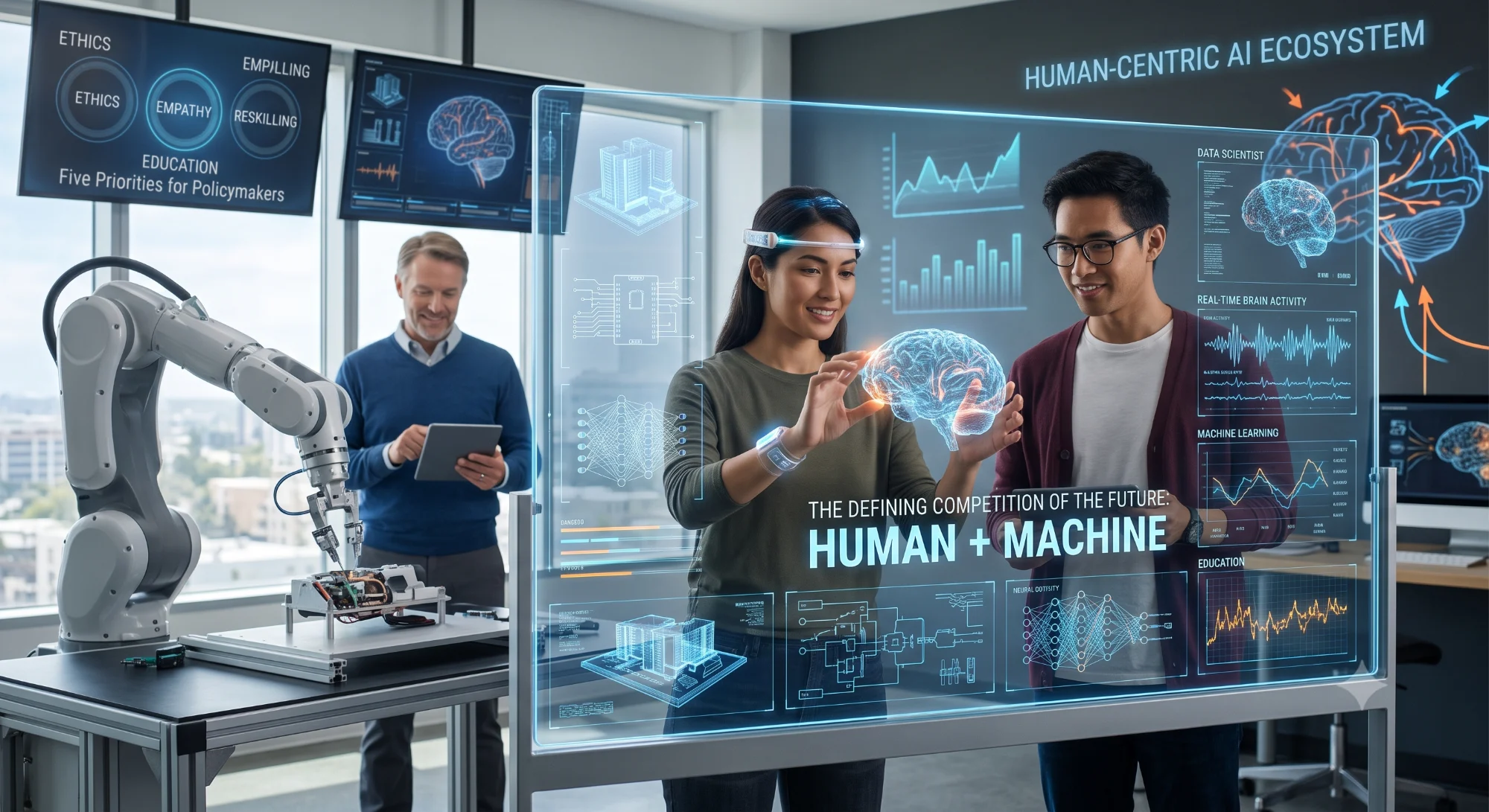
*"The defining competition of the future, therefore, will not be “Human vs. Machine,” but rather “Human + Machine.”"*
>
\ Artificial Intelligence (AI) and automation are reshaping economies, education, industry and governance at an unprecedented pace. As these technologies become deeply embedded in everyday life, one question dominates public debate: Will AI replace human workers, or will it fundamentally redefine the nature of human work itself?
>
\ These questions have given rise to both optimism and apprehension. On one hand, technological optimists envision a future where machines shoulder the majority of routine labor, allowing human beings to devote more time to creativity, scientific research and personal or spiritual growth. On the other hand, many fear rising unemployment, the obsolescence of existing skills and the gradual erosion of human judgment.
>
\ As is often the case with technological revolutions, the truth lies between these competing narratives. Artificial intelligence is neither poised to become a complete substitute for human beings nor is its impact likely to be insignificant. The future calls for the balanced perspective that Indian philosophical tradition describes as the “Middle Path”—an approach that embraces technological progress while keeping human dignity, wisdom and creativity at its very core.
>
\
**Beyond the Debate: A Balanced Perspective >
\ The impact of automation will be neither wholly destructive nor entirely beneficial. History demonstrates that every industrial revolution has eliminated certain occupations while simultaneously creating new forms of employment and demanding new competencies. Artificial intelligence represents the next chapter in this historical evolution.
>
\ Tasks that are primarily rule-based, repetitive, or dependent on processing vast volumes of data will undoubtedly become increasingly automated. Conversely, work that requires empathy, ethical judgment, contextual understanding, creative problem-solving and meaningful human interaction will become even more valuable.
>
\ Over time, many organizations are likely to discover that the best outcomes emerge neither from AI alone nor from humans alone, but from collaborative models that combine the strengths of both. The defining competition of the future, therefore, will not be “Human vs. Machine,” but rather “Human + Machine.”
>
\
**The Neuroscience of Learning and Adaptation >
\ Human intelligence is distinguished not merely by information processing, but by its capacity to learn, adapt and refine judgement through experience. This process relies on the coordinated functioning of multiple brain regions—including the prefrontal cortex, temporal and occipital lobes, basal ganglia, cerebellum and neurochemical systems such as dopamine—that together enable perception, reasoning, action and learning.
>
\ When performing a complex task, the human brain typically progresses through five interconnected stages: receiving external information; analysing and interpreting it within its context; formulating decisions and planning actions; executing the chosen course of action; and learning from the outcomes and integrating those experiences into future knowledge. This continuous cycle is what makes human beings more than mere processors of information; it enables them to grow intellectually through experience.
>
\ However, the widespread adoption of artificial intelligence also introduces an important challenge. If individuals become excessively dependent on AI for every cognitive task, their own abilities in analysis, memory, critical thinking and problem-solving may gradually weaken. Although long-term scientific research on this subject is still evolving, it is essential for educational institutions and workplaces to recognize and address this potential risk. For this reason, the purpose of AI should not be to replace the human mind, but to expand and augment its capabilities.
>
\
**Five Priorities for Policymakers >
\ Building a human-centered AI ecosystem requires more than technological innovation. It demands coordinated action across education, public policy, industry and research.\
**First, AI literacy should be integrated into mainstream education at schools and universities so that students learn not only how to use artificial intelligence effectively, but also how to leverage it to enhance their own capabilities. The approach should be: first, use AI to learn the skills or concepts they lack; then, apply that knowledge to perform the task using their own brainpower—rather than developing a habit of repeatedly relying on AI for every subsequent attempt.
**Second, governments and industries should establish systems for lifelong reskilling, enabling the workforce to continuously adapt to the evolving demands of the labor market. **Third, the development and deployment of AI must be guided by transparent and ethical regulatory frameworks that uphold fundamental principles such as privacy, accountability and fairness. **Fourth, greater support should be provided for research and innovation rooted in the principles of Human-Centric AI, where technology enhances human judgment rather than replacing it. **Fifth, economic policies should ensure that the productivity gains generated by AI are shared broadly across society, allowing technological progress to reduce social inequality instead of deepening it.
>
\ The question is no longer whether artificial intelligence will transform our world—the transformation is already underway. The real question is whether we can guide this change with wisdom, ethical responsibility and long-term vision.
>
\ The true purpose of artificial intelligence should not be to replace human beings but to amplify their capabilities. If we view AI not as a competitor but as a collaborator, it has the potential to elevate our creativity, productivity and human dignity to unprecedented heights. For this reason, the defining principle of the future is not “Human vs. AI,” but “Human and AI.” This balance, this wisdom and this Middle Path will be among the greatest necessities for the advancement of human civilization in the years to come.

Author
Shashank Shrivastava
I work at the intersection of social work practice and public policy research. Over the last decade my work has moved between village-level implementation and the evaluation frameworks that decide whether such implementation is judged a success.
More about the workComments (0)
- Be the first to respond.